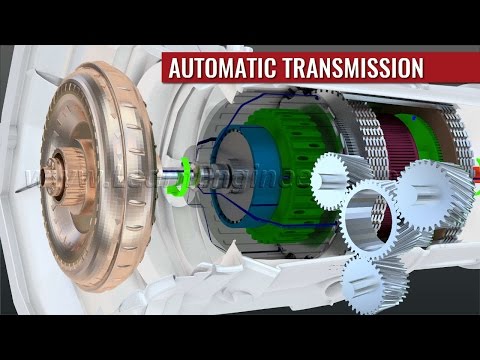
Torsen is a trademark of the JTEcht Corporation. The Torsen differential has many patented components and is the most unique and ingenious method of providing differential action while overcoming the traction difference problem. The internal components of a Torsen are quite different from that of a conventional differential. At the heart of the system lies a specially shaped gear pair assembly. Let’s see the cross-sectional shape of these gears at the mating point. As can be seen, one gear is a spur gear and the other one is a worm gear. A torson works on the simple principle of the worm gear–worm wheel: that is a spinning worm gear can rotate the wheel, but the rotating wheel cannot spin the worm gear. Throughout this discussion, just keep this principle in mind. A pair of such worm wheels are fitted with the case. So the engine power received by the case is transferred to the worm wheels. Each end of the wheels is fitted with a spur gear. Now, let's consider different driving scenarios. When the vehicle moves straight, the worm wheels will push and turn the worm gears. So both the drive wheels will rotate at the same speed. Please note here that, in this condition, the worm wheels do not spin on their own axis. In this condition, the whole mechanism moves as a single solid unit. When the vehicle is negotiating a right turn, the left wheel needs to rotate at a higher speed than the right wheel. This speed differential is perfectly supported in the torsion. The worm gear of the faster left axle will make the corresponding worm wheel spin on its own axis. On the other side, relative to the case, the slow right axle is turning in the opposite direction. Thus, the right worm wheel will spin in the opposite direction.
The meshing spur gears at the ends of the worm wheel will make sure that the worm wheels are spinning at the same speed. Thus, it guarantees a perfect differential action. Now, let's try to understand how the torsion overcomes the drive wheel traction difference problem. As you might be aware, when your vehicle encounters a situation as shown, the slippery wheel starts to spin very rapidly and will draw the majority of the engine's power. As a result, the vehicle will get stuck. But if a torsion differential is used in this case, as soon as the slippery wheel starts to spin excessively, the speed change will be transferred to the worm wheel. The right worm wheel transfers the speed change to the left worm wheel, since they are connected through spur gears. Here comes the tricky part: the left-side worm wheel will not be able to turn the corresponding worm gear, because, as we said, a worm wheel cannot drive a worm gear. As a result, the whole mechanism gets locked, and the left and right wheels turn together. This allows a large amount of torque to be transferred to the high-traction wheel, and the vehicle can thereby overcome the traction difference problem. To carry the load two more worm wheel pairs are added. If you’re familiar with the other technologies used to manage traction difference problem you may have noticed a great advantage of the torsion. While the other technologies allow the drive wheel to slip for a limited amount of time before it gets locked, in torsion the locking action is instantaneous, that means as soon as the vehicle encounters a traction difference track the wheels will get locked. To learn more about the clutch pack LSD technology, please check the next video. Thank you.